
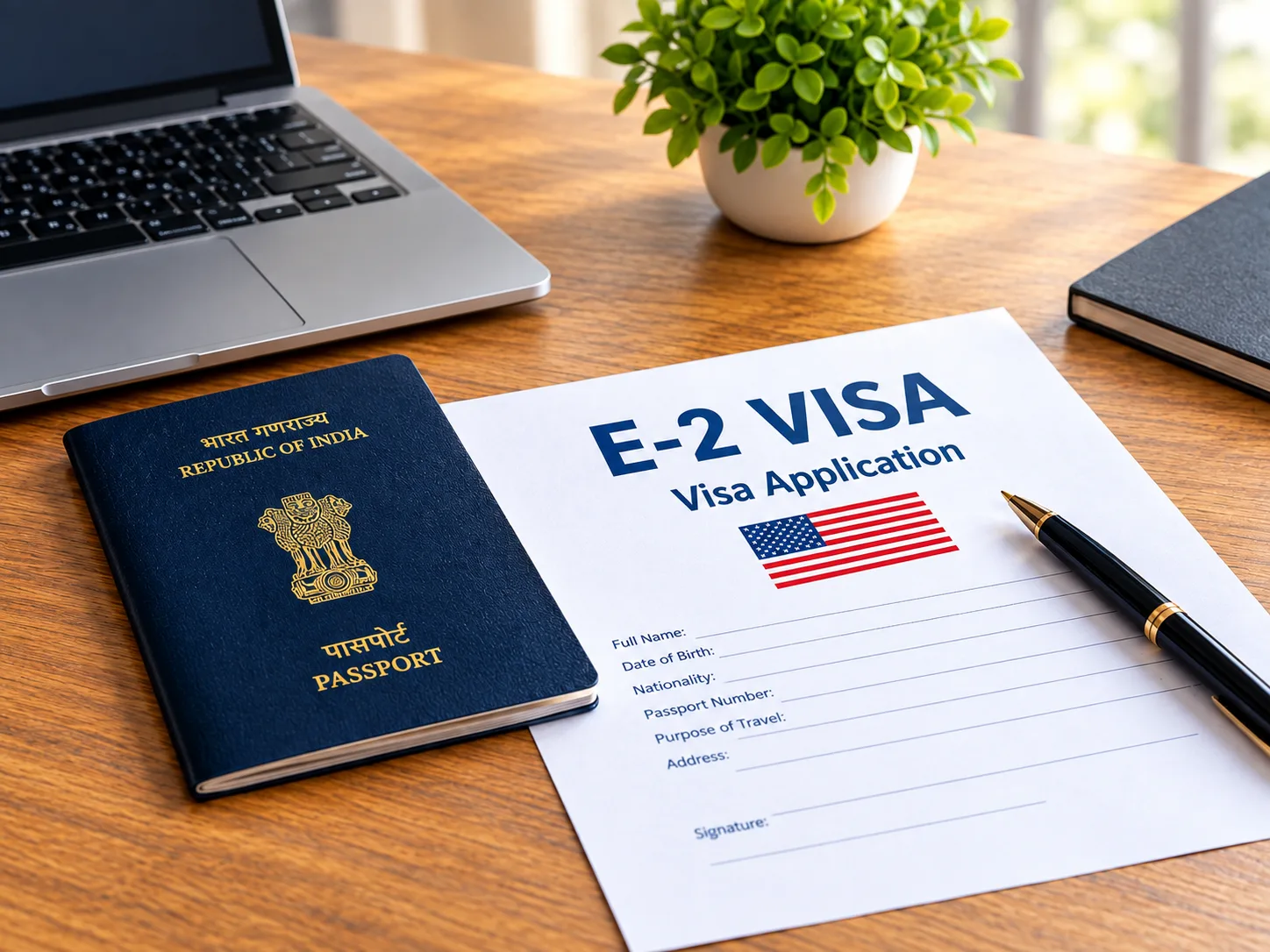
A founder had already done the hard part. He had the capital ready, a lease identified for a small US office, a hiring plan for the first two employees, and a business plan detailed enough to survive scrutiny from most investor visa reviewers. He had spent the better part of four months building the case, confident that a well-prepared plan would carry the application on its own merits.
Then an advisor he consulted before filing asked a question that had nothing to do with the plan itself: what passport was he holding? It wasn’t a formality. Buried inside the E2 visa requirements was a line that had nothing to do with the size of his investment, the strength of his hiring plan, or how well the business case had been built – the nationality printed on his passport.
This is where most research on E2 visa requirements goes wrong for Indian founders. It spends pages on the business plan, the investment threshold, and the operational details, and buries the one requirement that decides everything else before any of those details are even relevant.
The Real Problem: Indian Founders Assume Investment Is the Test
Most explanations of the E2 visa requirements are written for founders who already qualify by nationality, so the guidance jumps straight to investment size, business viability, and job creation. For an Indian founder, that framing skips the first and most decisive question.
At Indam Advisors, we have structured 47+ India-to-US setups, and the E-2 comes up in nearly every visa conversation, because it looks like the obvious answer to “I want to run my US business myself”. The founders who lose the most time are the ones who build out an entire business plan before checking whether their passport even puts them in the running.
What the E2 Visa Requirements Actually Involve
The E-2 is a nonimmigrant treaty investor visa, and the E2 visa requirements sit on four pillars: the applicant must be a national of a country that holds a qualifying treaty of commerce and navigation with the United States; the investment must be substantial relative to the business being funded; the capital must genuinely be at risk, not a loan or a guaranteed return; and the applicant must be entering the US specifically to develop and direct the business, not to work a passive role in it.
A detailed business plan sits underneath all four pillars. It has to show the investment amount, how the funds will be deployed, projected job creation, and the applicant’s active role in running the enterprise. None of this is optional, and reviewers scrutinise it closely. But it is also the part that gets solved second. The nationality requirement is what determines whether it is worth solving at all. Even where nationality clears the path, none of this replaces the underlying business formation work – the US entity still has to be set up correctly before any visa filing makes sense.
E2 Visa for Indian Citizens: Why the Answer Is Usually No
As of the current Department of State treaty list, India does not hold a qualifying treaty of commerce and navigation with the United States, which means Indian citizens do not meet the E2 visa requirements on the strength of an Indian passport, regardless of investment size or business quality. This sits alongside a small group of other large economies – China, Brazil, and Russia among them – that are similarly outside the E-2 framework.
This is not a documentation gap or a processing delay. It is a structural eligibility limit set by which countries have signed the underlying treaty, and it does not shift based on how well-prepared an individual application is.
E2 Visa Treaty Countries: How the List Actually Works
Eligibility under the E2 visa treaty countries list runs on citizenship, not residency. An Indian founder who has acquired citizenship of a treaty country – through naturalisation, descent, or a citizenship program – can potentially apply for an E-2 using that passport. Where citizenship was obtained through an investment-based program, current federal law generally requires the applicant to have held that citizenship and to have been a resident in that country for a continuous period before the E-2 application can rely on it.
For most Indian founders, this route is neither quick nor practical. It depends on a citizenship process that can take years and carries its own cost and residency conditions, long before an E-2 filing is even possible. It is worth knowing this pathway exists. It is rarely the fastest path to a US business.
Not sure which visa category actually fits your situation? The Indam US Entry Assessment from Indam Advisors is a structured diagnostic that maps entity, visa, and compliance pathways specific to your business and your passport.
US Business Visa Types Indian Founders Actually Use
Once the E2 visa requirements rule India out, three US business visa types come up most often for Indian founders building a genuine operating presence. Each route comes with its own filing process, and getting the right immigration legal support early avoids costly missteps later.
L-1 intracompany transferee: available to an executive, manager, or specialised-knowledge employee of an existing Indian company that is opening or already operating a related US entity. It generally requires at least one year of qualifying employment abroad within the past three years and a genuine parent-subsidiary or affiliate relationship between the two companies.
O-1 extraordinary ability: open to founders who can document a sustained record of achievement in their field, evaluated against specific USCIS criteria. It has no treaty-country restriction and no minimum investment, but the evidentiary bar is high and case-specific.
EB-5 immigrant investor: a direct path to a green card rather than a temporary visa, requiring an at-risk investment of $1,050,000, or $800,000 if the new commercial enterprise is principally located in a targeted employment area or qualifying infrastructure project, along with the creation of at least ten qualifying US jobs. It carries no treaty-country requirement, which is exactly why it comes up so often for Indian founders once the E-2 is ruled out.
Unlike the E-2’s nationality rule, none of these three routes depend on the passport a founder holds – the qualifying facts sit in the business, the individual’s track record, or the capital, not in a treaty list.
What This Looks Like in Practice
A founder came to Indam Advisors fully set on meeting the E2 visa requirements, having already researched the investment threshold and drafted a rough business plan on his own. Once we reviewed his actual facts – an Indian passport, no dual citizenship, no existing US-linked entity abroad – it was clear the E-2 was never going to be available to him, no matter how the plan was refined.
What he actually had, without realising it, was a strong L-1 case: a running Indian company, a genuine business reason to open a US affiliate, and a role that qualified as managerial. The visa he needed was never the one he had researched. It was the one that matched the business he already had.
A presence in the US is not the same as a position in the US. If you are weighing visa options for a US business, the Indam US Entry Assessment gives you a personalised map of which pathway actually fits your facts.
Frequently Asked Questions
What are the E2 visa requirements?
Under the E2 visa requirements, the applicant must be a national of a country holding a qualifying treaty of commerce and navigation with the US, a substantial at-risk investment in a real US business, and an active role developing and directing that business, supported by a detailed business plan.
Can Indian citizens apply for an E-2 visa?
Generally no. India does not currently hold a qualifying treaty with the United States for E-2 purposes, so Indian citizens are not eligible to apply on the strength of an Indian passport, regardless of investment size.
What does an E2 visa business plan need to include?
Beyond the core E2 visa requirements, the plan needs to show the investment amount and source of funds, how the capital will be deployed, projected staffing and job creation, and the applicant’s specific role in actively running the business, not just funding it.
Which countries are on the E2 visa treaty countries list?
Over 80 countries hold qualifying treaties with the US, including most of Western Europe, Japan, South Korea, Canada, and Turkey, among others. India, along with China, Brazil, and Russia, is not currently on that list, and eligibility is based on citizenship rather than where the applicant lives.
What is the best US business visa for an Indian founder who can’t use the E-2?
It depends on the founder’s specific facts. An existing Indian company with a genuine US expansion case often points to the L-1, a strong individual track record points to the O-1, and founders with significant capital and a longer timeline often consider the EB-5 investor green card route.