
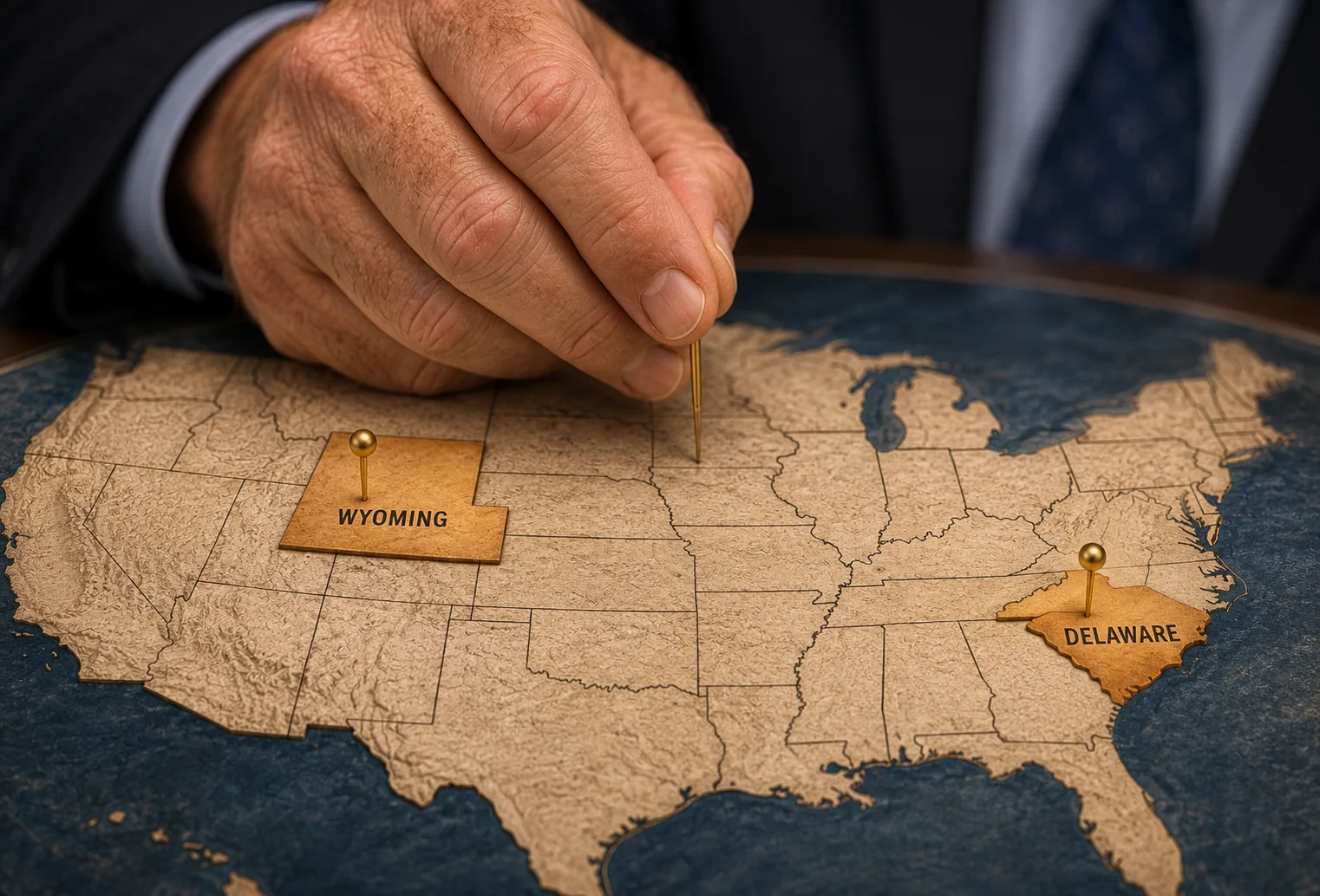
Ask ten people where to form your US company, and nine will say Delaware. It’s the reflex answer – the one your US contact gives, the one the incorporation website nudges you toward. Then you see the bill. Delaware charges a flat $300 franchise tax every year. Wyoming charges $60. Same country, same federal rules, a fivefold difference in state cost, and most Indian founders pick the expensive one without ever asking why. It’s the first fork in the road for any Indian-owned company, and getting the Delaware vs Wyoming LLC decision wrong at the start is expensive to undo later.
The Delaware vs Wyoming LLC question is real. But it’s the second question, not the first. And answering it well starts with knowing what each state actually gives you and what neither of them lets you escape.
Here’s the pattern we see. A founder spends two weeks agonising over the state – Delaware for the prestige, Wyoming for the savings – then forms the entity through an online service that never mentions the filings that come after. The state was the visible decision. The compliance calendar was the one that mattered.
Indam Advisors has structured 47+ India-to-US setups, and we’ll tell you plainly: for most Indian founders, the state you choose changes your annual cost and your privacy, but it doesn’t change your federal tax life at all. Not by a rupee. The IRS treats a Wyoming LLC and a Delaware LLC identically.
So the honest way to approach state selection for your US company is to stop treating it as a prestige contest and start treating it as a fit question. What are you actually building, and who is going to fund it?
What Delaware actually gives you
Delaware’s reputation is earned, not marketing.
Its real asset is the Court of Chancery – a business-only court with judges, not juries, and more than a century of case law on corporate disputes. For a company that will raise institutional money, that predictability matters. Venture funds and sophisticated investors expect a Delaware entity. Roughly two-thirds of Fortune 500 companies are incorporated there. The paperwork is standard, the lawyers know it cold, and nobody on a cap table has to ask questions.
The cost of that familiarity is the Delaware franchise tax. For an LLC it’s a flat $300 a year, due June 1, with no annual report to file – simple and predictable. For a C-corporation it’s a different animal: a share-based calculation that starts modest but can climb into the thousands as you authorise more stock. You’ll also need a registered agent with a Delaware address, typically $50 to $300 a year.
Here’s the nuance most founders miss. If you’re raising venture capital, the right Delaware answer usually isn’t an LLC at all – it’s a Delaware C-corporation.
What Wyoming actually gives you
Wyoming competes on three things: cost, privacy and simplicity.
The annual report license tax starts at $60, or $0.0002 per dollar of assets you hold inside Wyoming and since most non-resident founders hold no assets in the state, $60 is what they pay. There’s no state income tax, no corporate income tax, and no franchise tax. A Wyoming LLC for non-residents is about as cheap as a US entity gets to maintain – realistically $110 to $260 a year once you add a registered agent.
Privacy is the other draw. Wyoming doesn’t ask for member or manager names on its public filings – the statute simply doesn’t require them. Your ownership lives in your operating agreement, not on a government website. For founders who’d rather their name not be searchable against a US company, that’s meaningful.
What Wyoming doesn’t give you is investor gravity. No venture fund is more comfortable because you chose Wyoming. If your plan is a bootstrapped SaaS, an e-commerce brand, a consulting or services firm – funded by you, not by a VC – that absence costs you nothing.
The requirement in neither state lets you skip
Now the part the state debate distracts from.
Whichever state you pick, two things are identical. First, the registered agent requirement – both Delaware and Wyoming require you to maintain a registered agent with a physical address in that state, someone to receive legal and government mail on the company’s behalf. You cannot use your address in India. This is not optional in either state.
Second, and far more important, the federal layer. A foreign-owned single-member LLC has to file Form 5472 with a pro-forma Form 1120 every year – even with no income and missing it carries a $25,000 penalty under IRC §6038A. That penalty is identical whether your certificate says Wyoming or Delaware. The state you agonised over doesn’t touch it.
This is the point. The state decision is a cost-and-privacy decision. The compliance decision – the one that actually carries five-figure risk – sits at the federal level and looks the same from either state.
If you’re not sure which structure fits what you’re building or whether the entity you already formed matches your funding plans – that’s worth resolving before you’re locked in. The Indam US Entry Assessment is a structured diagnostic that maps your goals, your capital path and your compliance obligations to the right state and structure. It isn’t a sales call. It’s a personalised map of where your US company should actually sit.
So which is the best state to form an LLC for non-residents?
Framed as a straight Delaware vs Wyoming LLC comparison, the honest answer depends on one question: are you raising outside capital?
If yes – if institutional investors or a US venture round are in your plan – form a Delaware C-corporation. The Court of Chancery, the standard documents and the investor familiarity are worth the extra cost, and the structure is what funds expect.
If no – if you’re bootstrapping a SaaS, e-commerce, consulting or services business on your own capital – a Wyoming LLC is usually the better fit. Lower cost, stronger privacy, simpler upkeep and nothing about it that a self-funded business needs to apologise for.
And the Delaware LLC specifically? It sits in the middle – Delaware’s name without the C-corp machinery. For a handful of founders that middle ground makes sense. For most non-residents, you’re paying $300 a year for a prestige that a private, bootstrapped business never actually cashes in.
That’s the framework. It isn’t about which state is best in the abstract. It’s about which state is best for you.
A founder came to us last year with his mind made up. A US contact had told him what everyone gets told – form a Delaware C-corp, that’s what serious companies do. He ran a profitable services business selling to US clients. Self-funded. No plans to raise a rupee of outside money. And he was days from filing.
We asked the one question nobody had. Are you raising capital? He wasn’t. He’d never even considered it. He wanted a clean US presence to invoice American clients and hold a US bank account – nothing more.
A Delaware C-corp would have handed him double taxation on his profits, a share-based franchise tax to calculate every year, and a corporate formality regime built for companies with boards and investors he didn’t have. We stopped the filing. We formed a Wyoming LLC instead – single-member, privacy intact, sixty dollars a year to maintain and set his treaty position and federal filings up correctly from the start.
He saved himself years of unnecessary cost and complexity for the price of one honest conversation before filing.
The wrong structure is expensive precisely because it’s invisible – it doesn’t hurt on day one. It hurts every year after.
The Delaware vs Wyoming LLC debate is worth having, but not in the abstract and not by defaulting to whatever your last conversation recommended. The right state falls out of two things: what you’re building and how you’ll fund it. Get those clear, and the state chooses itself.
If you want that clarity before you file – or a second look at an entity you’ve already formed – start with the Indam US Entry Assessment. It maps your situation to the right state, the right structure, and the federal filings that apply either way, so you form once and form correctly.
Frequently asked questions
Is Wyoming or Delaware better for a non-resident LLC?
For most non-resident founders who aren’t raising outside capital, Wyoming is better – lower cost, stronger privacy, and no state income tax. Delaware is the stronger choice when you plan to raise institutional investment, in which case a Delaware C-corporation is usually the right structure.
How much does a Delaware LLC cost per year?
A Delaware LLC pays a flat $300 annual franchise tax, due June 1, with no annual report required. You’ll also need a registered agent with a Delaware address, typically $50 to $300 a year.
Do I need a registered agent in both states?
Yes. Both Delaware and Wyoming require every LLC to maintain a registered agent with a physical address in the state of formation. A non-resident cannot use an address in India for this purpose.
Does choosing Wyoming reduce my US federal tax?
No. State choice doesn’t change your federal obligations. A foreign-owned single-member LLC must file Form 5472 with a pro-forma Form 1120 regardless of state, and the $25,000 penalty for missing it applies identically in Wyoming and Delaware.
Indam Advisors has structured 47+ India-to-US setups. A presence in the US is not the same as a position in the US – and the right state is only the beginning of the design.